Alliance for
Action Aid -
founded, led and rooted in
South Sudan.
AFAA is a South Sudanese organisation, registered in Juba, appointed by the Ministry of Health, and staffed by people from the communities it serves.

- THE FOUNDER
Michael Gatluak Tuok
Michael Gatluak Tuok was born in Maluak Boma, Nyuong Nuer, a village in Upper Nile with no hospital, no skilled birth attendants, no immunisations, and no primary healthcare of any kind. Communities relied on traditional herbs. The nearest help, if you could reach it, was hours away.
In 1987, aged thirteen, Michael was forced to leave. He walked for over a month and two weeks. To reach Ethiopia he crossed the Nile, without adequate food or clothing. Many of the boys around him did not survive the journey. He was taken from his parents and made a child soldier. But he also, through international aid, received his first education, completing Years 1 through 8.
He returned to South Sudan when Ethiopia broke into war. Supported by the UNHCR, he completed secondary school. He was then recruited by COSV, an Italian NGO operating a Primary Health Care Centre in Nyal, and began as a vaccinator, immunising children under five. He went on to train for nine months as a Community Health Worker, covering curative consultation, immunisation, maternal and child health, antenatal care, nutrition, and laboratory investigation. He became the best in his cohort. He was asked to stay as a tutor and school administrator, staying to train the next generation of community health workers for three years.
In 2004, COSV sponsored him to study for a Diploma in Clinical Medicine and Public Health at Maridi Health Science Institute. The 2005 Comprehensive Peace Agreement was signed while he was in college. He graduated as a qualified Clinical Officer in 2006, completed his internship at Bentiu Hospital and then worked as a Clinical Officer for GOAL in the Southern Blue Nile Region, in Kurmuk locality, from 2008 to 2012, through one of the most volatile periods in the region's recent history.
He went on to work for CARE International as County Health Coordinator for three years, and for UNFPA. Between 2015 and 2017, he completed a Bachelor's degree in Public Health.
In 2016, Michael co-founded Alliance for Action Aid alongside community elders and South Sudanese health professionals who shared his diagnosis: that their communities lacked services, were chronically overlooked by outside organisations, and needed people with local knowledge and long-term commitment who would stay.
Today, AFAA presents at national health, WASH, and food security and livelihoods cluster meetings chaired by South Sudan's national line ministries and co-chaired by WHO and UNICEF. It is not a peripheral organisation. It is a trusted voice at the highest levels of South Sudan's health system.


Ideas have to come from the community. You cannot impose on them.
You must engage them, meet with stakeholders, host focus group discussions. You have to understand what they want. That is the best way to make development happen, and for it to be sustainable.
MICHAEL GATLUAK TUOK · FOUNDER & EXECUTIVE DIRECTOR, AFAA
- A DECADE OF SERVICE
From one mobile clinic
to an entire county's health system
2016
AFAA is founded
Michael Gatluak Tuok establishes Alliance for Action Aid alongside community elders and South Sudanese health professionals from Panyijiar County. Registered as a national NGO on 16 December 2017.
c. 2020
Field operations begin in Panyijar
AFAA establishes its first Primary Health Care Unit (PHCU) at Majak, Nyal Payam, and launches a mobile health clinic. For many communities in Panyijiar, this is the first reliable healthcare they have ever had.
2021 - 2023
Consecutive floods - AFAA keeps going
Three successive years of catastrophic flooding isolate communities across Panyijiar. Roads become rivers. AFAA deploys its mobile team by canoe to reach cut-off populations and continues to expand its reach. By March 2024, AFAA is reaching over 50,000 people per year across its programmes.
2022 - 2023
28,986 Consultations in a single year
Despite floods, COVID-19, and security challenges — with support from Vitol Foundation — AFAA delivers 28,986 consultations, 450 ANC visits, and 187 safe deliveries at Majak PHCU and mobile outreach sites.
June 2024
The Nyal PHCC collapses - AFAA steps in
International NGOs CUAMM and IMC phase out of the county's central health facility, leaving 49,252 people with no functioning PHCC. The International Rescue Committee commits to take over but does not begin. AFAA — already the only active health implementer in the county — is formally appointed by South Sudan's Ministry of Health as lead organisation for Panyijiar's primary health system.
December 2024
Nyal PHCC reopens - CEmONC centre restored
AFAA officially launches operations at Nyal PHCC, reopening the Comprehensive Emergency Obstetrics and Newborn Care (CEmONC) centre that had been non-operational for years. Within weeks, the surgical team is performing caesarean sections and emergency procedures 24 hours a day.
December 2024 - June 2025
21, 827 Consultations in seven months
In the seven months following the PHCC reopening, during a cholera epidemic and active flooding, AFAA delivers over 21,000 outpatient consultations, performs emergency surgery including caesarean sections, contains the cholera outbreak with zero deaths, and drives maternal mortality below the national average. Full figures available on the Impact page.
2026 onwards
The work continues
AFAA is expanding its Community Health Worker network, developing the Palual PHCU to serve over 1,800 displaced people, and seeking multi-year philanthropic funding to sustain and grow its integrated health model across Panyijiar and Rubkona Counties.
Our Approach:
Local Leadership
Community-led methodology
Every decision AFAA makes begins with the community. Focus groups, suggestion boxes, meetings with local leaders and elders. Before any intervention is designed, AFAA listens. This is not just for the sake of courtesy, it is an important strategic method. Imposed solutions do not last. Community-owned ones do.
Permanent local presence
AFAA was built from within Panyijiar, by people who were born there, trained there and chose to stay. That rootedness is embedded in AFAA's model. Deep community relationships mean interventions are informed by what communities actually need. Local knowledge means resources are not wasted on approaches that don't fit the context. Long-term commitment means results compound rather than disappear when a funding cycle ends. Where other organisations face the inherent challenge of operating far from home, AFAA is already there and has been for a decade.
Integrated programme model
Health cannot be separated from food, water, safety, or economic security. AFAA's model addresses all of these together. AFAA links its health facilities to community health workers, nutrition screening, WASH programming, livelihoods support and protection services. Each component reinforces the impact of the others.

- THE ORGANISATION
What AFAA is
AFAA is a national, non-profit, non-political NGO. It was formally registered in South Sudan on 16 December 2017. It is not an international organisation with a headquarters abroad. It does not employ expatriate staff to do work that South Sudanese professionals can do.
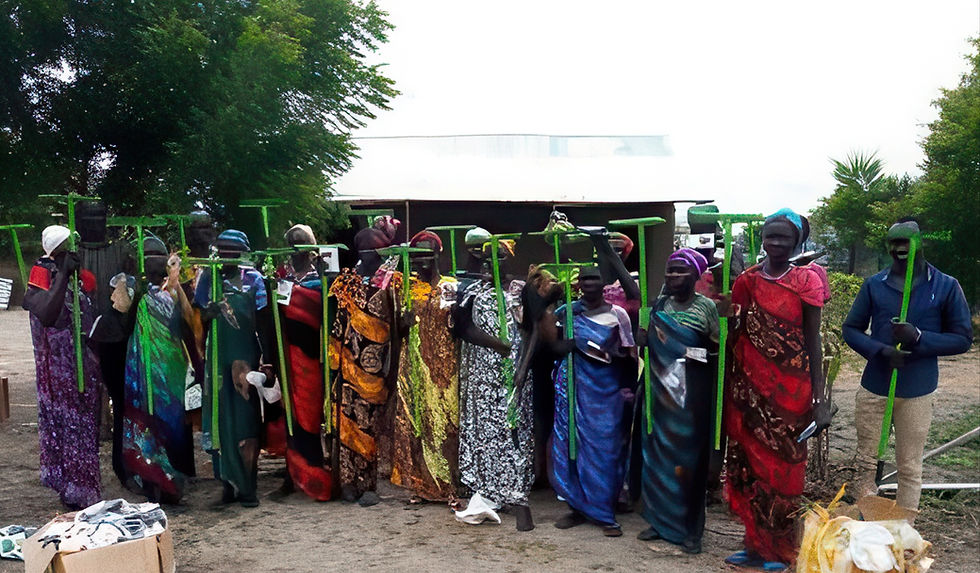
AFAA is run by and staffed by South Sudanese people, many of them from the communities it serves. AFAA is deliberately rooted to its operation and can only work so efficiently as a consequence. Local staff have the language, the relationships, the cultural context and the long-term commitment that make the improvements happen.
AFAA presents its findings and advocacy at national cluster meetings chaired by South Sudan's Director General of Health, the Minister of Health, and the WHO. It has been trusted with the lead mandate for an entire county's primary health system by the Ministry of Health. It is accountable to every level: the community it serves, the government it works alongside, and the donors whose resources it stewards.
As of July 2025, some staff were delivering healthcare without salary due to funding gaps.
KEY INFORMATION
Founded: 2016
Registered: 16 December 2017
Type: National NGO, non-profit
Primary area: Panyijiar County, Unity State
Also active in: Rubkona County
Head office: Munuki Block C, Gudele Road, Juba, South Sudan

CORE TEAM
Michael Gatluak Tuok — Executive Director & Founder
Diana Itima — Health Program Manager
James Thiey — Operations Manager
Mule Anthony Moini — FSL Program Manager
Faith Wangari — Health Advisor
Fekira Night — Finance & Admin Officer